












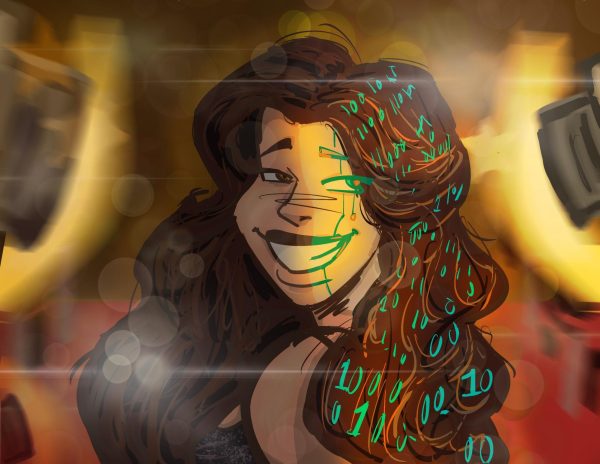
As Lila Gregorio ‘27 scrolls through social media, her finger stops on an AI-generated image. She had always been certain about pursuing a career in graphic design, but as she watches AI-generated work flood her feed, she is not sure what that career looks like anymore.
47% of U.S. college students have considered switching majors because of AI concerns according to the Lumina Foundation-Gallup 2026 State of Higher Education Study, and right now, applying high school students are asking the same questions.
With seniors reflecting on their recent college decisions and juniors beginning to curate their college applications, many students are facing a question previous classes never had to consider.
Should high school students actually be factoring AI into their college and major decisions, and if so, how can that be done when economists are divided on what the future of AI holds?
Sarah Hock ‘26 is planning on studying nursing in college.
“I have thought about how AI could impact nursing as a career,” Hock said. “It’s all so up in the air though, so I think planning early and changing how I approach it is better than straying away from what I am passionate about.”
Rather than viewing AI as a threat, she views AI as a potential benefit to nursing and something she can work with.
“I just don’t even see it being possible for AI to replace nurses with the human aspect of the job, and if anything, it could benefit them by handling repetitive administrative tasks like documenting,” Hock said.
Kiera Doogan ‘26 considered pursuing a writing-related field.
“I have always enjoyed writing so I’ve considered careers along those lines, maybe like a journalist or author,” Doogan said. “But if people are already using AI to write essays, it’s hard not to think about what that means for actual writing jobs.”
Doogan said she sees AI having an effect on the real world outside of the classroom.
“And seeing reporting jobs actively being replaced really makes me hesitant,” she said. “like, it’s not even an if to me because it’s already happening.”
As confusion builds among students and they think through the possibilities and uncertainties surrounding AI, counselors at Mount are there to think it through with them.
College counselor Mary-Kate Kaminski is one of the counselors at Mount navigating students’ concerns, and the concern she sees most is actually around essay authenticity, not major selection.
“It is good to hear Mounties are thinking about the realities of AI and their future careers, majors, and college selections,” Kaminski said.
While she agrees AI is an important factor to consider in the college admission process and how it will impact the job market, she emphasizes the irreplaceability of human qualities.
“Networking, soft skills, and human interactions will never be able to be replicated by AI in the same way,” Kaminski said.
Beyond Mount, economists and researchers’ predictions remain divided on the level of impact AI will have on future work.
Some validate concerns about disruption in professional fields, like Goldman Sachs, whose research estimates that about 25% of current U.S. work tasks could be automated by AI.
On the other hand, a 2026 Federal Reserve Bank of Boston paper found that large-scale unemployment spikes have not yet materialized, and firms adopting AI report productivity gains rather than widespread job losses.
While students, counselors, and economists give their different perspectives on AI’s future impact, uncertainty leaves students no definitive answer. As they make college decisions, some think it will become a helpful tool and others worry it may replace entire industries. Either way, students are left to make decisions in a time where uncertainty coexists with possibility.
So, as students like Lila Gregorio scroll through AI-generated content, they no longer just question what they want in a career, they are forced to question if that career will want them in an unfolding future .
“Seeing AI-generated images come up more and more definitely makes me question graphic design, but I’m not gonna let it entirely dictate my decision,” Gregorio said.