
























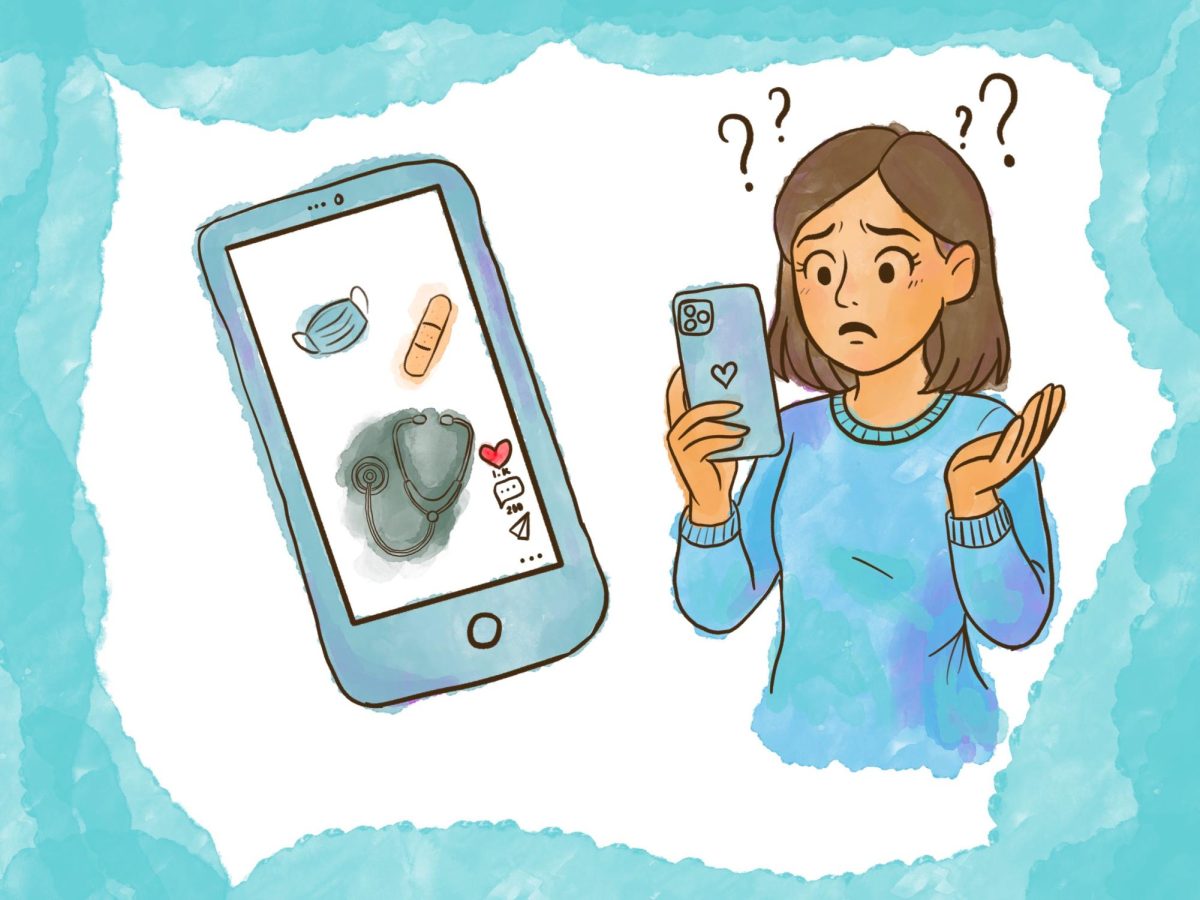
Would you trust your doctor if they solely got their information from TikTok? Of course not! Lately, there has been an increase of doctors providing information through short-form content apps, like TikTok and Instagram. These accounts have millions of views and they spread faster than most medical websites and journals.
Depending on which genre of TikToks you watch, whether it is skincare or mental health advice, some doctors risk posting misinformation for fame while others want to help society advance physically and mentally. As these accounts increase, a major question grows with it: “Are these videos helping or harming the relationships between patients and professionals?”
Although social media is spoken about in a negative connotation, certain types of content can be healthy and positive to intake.
For example, doctors cater accessible and short videos to the general public with data-driven information. These videos can actually positively affect the relationships patients have with their physicians. Health care providers encourage their patients to do research and want to have productive conversations about possible ways to fix or ease their patient’s condition.
Dr. Philip Lee, who is a noninvasive cardiologist at Novant Health Heart & Vascular Institute – Elizabeth, mentions that, “The better a patient is educated, the more they understand their disease process or issue, the more likely they will be to work on it.”
Although society has a general fear towards information taught through social media, Harvard Public Health’s Sasha Hamdimi claims that “…it has powerful benefits and incredible promise for expanding access and education.”
Unfortunately, with the increase of “medinfluencers”, there is also an increase of false information that can lead to uncertainty and, even worse, wrong diagnoses. Many times, patients come to doctors about conditions, or even have gone through treatment for these conditions, that could lead to harmful outcomes on their bodies.
Patients even feel the fear of missing out on these famous treatments, ultimately ruining their health more than before. Alpana Mohta with MDLinx claims that even some doctors on TikTok are actually getting their licenses revoked, like Dr. Roxy who harmed patients while livestreaming surgeries.
Mohta continues writing about some medinfluencers, like Dalya Karezi, pretend to be medical professionals while making TikToks about health conditions that impact large communities, including cancers, HIV, and fertility. Hamdimi writes that social media “…could be how future generations get the information they need to feel good about themselves.”
This claim validates many people’s feelings when it comes to future generations’ sources of information.
Violet Binczewski ‘26 stated that medical influencer Doctor Mike often appears on her social media “For You” pages. She expressed her respect for Doctor Mike, since he is licensed in his profession and gives out genuine medical information for a broader audience to digest, and that she respects that he calls out medical influencers who do not have any credentials or medical training.
Binczewski continues, “We need to make sure that people we get medical information from are licensed,” reinforcing the belief of many communities: that society should not risk its health and take advice from someone who is not specialized in their field.
Mrs. Maria Ryan, a Biology teacher, adds, “Social media can make health information feel more accessible, and sometimes a short video can even prompt someone to see a doctor—which can be a good thing. But it’s not always reliable; posts can leave out key context or be based more on opinion than science.”
Content on social media can be extremely difficult to navigate and Mrs. Ryan claims that “…it’s so important to teach media literacy…” Pausing and checking credentials of those who you get information from is crucial regardless of what is consumed.
Mrs. Ryan said, “Reliable sources back up their claims with evidence and explain both benefits and risks, while misinformation often relies more on emotion and certainty.”
While social media can help us access information, it is important to prioritize those with licenses and verify sources of information. In the end, media literacy and critical thinking is key when navigating the tough landscape of medical advice.



Joyce Phoenix • Dec 4, 2025 at 10:55 am
Well done so proud of you